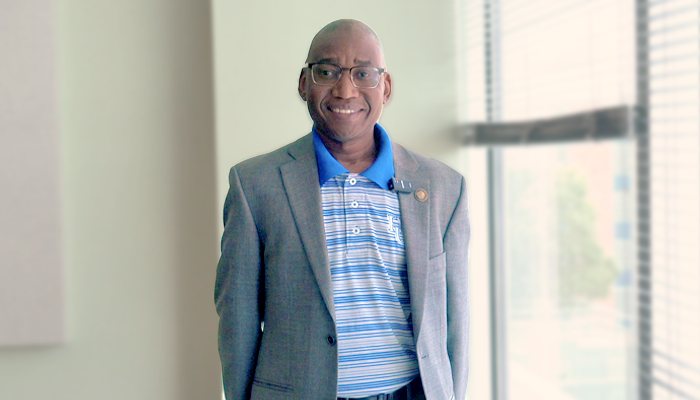


As a professor in Hampton University’s Department of Electrical and Computer Engineering,
Dr. Otsebele Nare has spent nearly two decades educating future engineers while advancing research in emerging technology, optimization, and cyber-physical systems. His work spans artificial intelligence, machine learning, and hardware systems, but at the heart of it all is a passion for helping students connect theory to real-world applications. As part of the Research Institute for Tactical Autonomy (RITA), Dr. Nare is helping prepare the next generation of engineers to tackle rapidly evolving challenges in autonomy while ensuring they never lose sight of the fundamentals.
Can you share a little about your background and what brought you to RITA?
I’ve been at Hampton University for 18 academic years. Before that, I completed my master’s degree at Morgan State University and worked there for about a year and a half as a research engineer in the School of Engineering.
My path to RITA is really a combination of the work I’ve done over the years. My doctoral research focused on multi-objective optimization, which involved elements of artificial intelligence and machine learning, particularly genetic algorithms. When I came to Hampton, I continued building on that work while also training students and developing curriculum.
When RITA was established, many of the activities aligned with what we were already doing. We had just launched a cyber-physical systems security program and were looking at starting a software engineering program within our department. Those initiatives fit well with the skills and research areas that support tactical autonomy, so it was a natural fit to join the team that developed Hampton’s proposal.
What excites you most about your field of research?
I’ve worked across a number of different areas, but what excites me most is emerging technology. It connects to so many different stages of education and research because technology is always changing.
Interestingly, some of the emerging technology work we’re doing through RITA also connects with projects I’ve worked on in K-12 education. It’s rewarding to see those ideas span from local school programs all the way through collegiate research.
What is the most rewarding part of your work?
For me, it’s that moment when a student really gets it.
It’s one thing for something to work, but it’s another when a student understands a complex concept and can connect the mathematics, physics, and science to a practical engineering application. Seeing students make those connections is what makes you want to get up every morning and do it again, even when it’s difficult. You know you can make a difference and have an impact on another student.
What impact do you hope your work will have over the next five years?
Technology is moving so quickly that five years feels like a very long time. Things are changing every few months.
Even with all of those advances, I believe the fundamentals don’t change. AI may take over many basic activities, but we’ll always come back to the human element and understanding the physical nature of engineering systems. In tactical autonomy, we still have to think about the hardware. We need to train students to understand how to strategically optimize hardware and combine it with emerging technology for future implementations.
Rather than thinking only five years ahead, we also need to evaluate progress in three- to six-month increments because that’s how quickly technology is evolving today.
What advice would you give students interested in this field?
Be excited and be willing to learn.
You’ll build on the fundamentals, but you’ll also be applying them in practical ways. You can’t go into this field thinking you already know everything. Even after years of experience, we’re still learning every day as we solve new problems. That willingness to keep learning is essential.