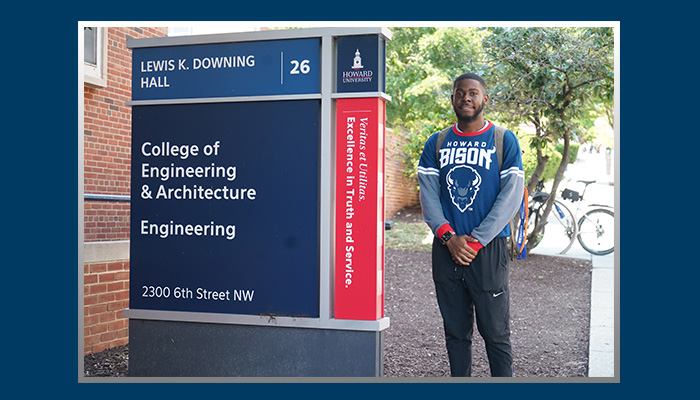
Caleb Cooper is a second-year atmospheric science Ph.D. student at Howard University and a 2026 participant in RITA’s Summer Internship Program. His connection to RITA began as an undergraduate at Tougaloo College, where he served as an undergraduate research assistant while developing his experience in machine learning. After meeting RITA Executive Director Dr. Sonya Smith during his senior year, Cooper saw an opportunity to continue building upon that foundation at Howard while exploring the intersection of atmospheric science, machine learning and engineering. Today, he balances multiple research projects, including his dissertation work, while pursuing a longtime goal of contributing to research with real-world impact.
Q: What inspired you to join RITA?
Mainly, it was actually Dr. Smith. I met her when she came out to Tougaloo my senior year of college, and she said I would be a really great fit here at Howard and as part of RITA. I already had a little experience in machine learning, and just seeing the engineering side and the atmospheric side of everything made me even more interested.
Q: What initially drew you to your field of study?
I always had a dream to work for either the Department of Defense or NASA. Once I saw this opportunity, especially with the advancement of machine learning and AI, I thought I could really apply my skills to that and be a part of it.
Q: Who has been a mentor or role model for you during your time at RITA?
Definitely Dr. Reliford. She was basically a friend to me before I even knew about RITA or this program here at Howard. Meeting her before she even became a doctor and seeing how she has matured throughout the process has been really inspirational. I kind of want to be like her one day.
Q: What does a typical day look like for you?
A typical day, I wake up and make sure I’m at the office at 9:00. I have multiple projects I’m working on: first, my dissertation proposal, then my project with Dr. Reliford and another project with Dr. Walton. I split my time between those three projects.
There’s a lot of coding involved, a lot of organizing and a lot of research and reading articles. I’ve really just had my head in the laptop, trying to advance all of these projects.
Q: How has your time here shaped the way you see your future career?
Especially with my classes here, learning about atmospheric sciences and having hands-on research experience has really helped me. I had those dreams of working for NASA, but I’ve realized that it’s much more tangible and not as far away as I once thought.
Q: How does your research connect to RITA’s mission and the broader field of tactical autonomy?
The main connection to tactical autonomy comes from making sure autonomous systems can trust the information they’re receiving from their sensors. With my dissertation, I’m looking at how factors like atmospheric conditions and the movement of a drone platform can affect PM2.5 sensor measurements and how machine learning can be used to correct for those effects and improve the fidelity of the data.
This also coincides with the work I’m doing with Dr. Rawal under RITA on uncertainty quantification. A lot of that work is essentially asking whether a model knows when it might be wrong or when it doesn’t have enough information to make a reliable prediction. That same idea can apply to autonomous systems operating in real-world environments. By accounting for changing conditions and platform telemetry, sensor readings can be corrected as conditions change. If a sensor still isn’t providing reliable information, the system should be able to recognize that uncertainty rather than making a decision as if everything is normal.
Q: What impact do you want to make in your field?
I want to develop something or contribute something to society that makes it easier for everybody to use or operate in some capacity. I feel like one of the best ways to do that is through machine learning. There are different ways to do that, and part of my dissertation is tackling that question in one way.