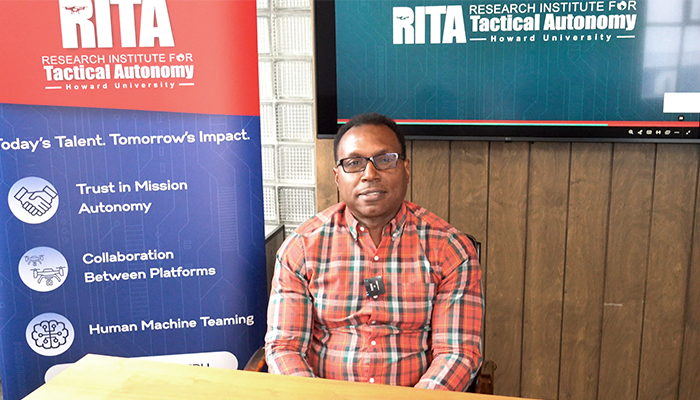


Mr. Shannon Arnold serves as a Senior Research Scientist at the Research Institute for Tactical Autonomy (RITA). With experience spanning NASA, defense research, and trusted AI initiatives across the Department of War, Arnold has spent his career advancing technology and innovation in support of national security. We spoke with him about his career journey, the future of AI and autonomy, and the importance of building systems that operators can trust.
You have worked at the intersection of research, policy and national security. What initially drew you to this space?
My initial draw to this space was kind of multifaceted. I was always fascinated with STEM. I took an opportunity early on to jump into the arena of space, where I worked at NASA Langley Research Center for about seven years.
That led me to understanding the application of technology development, so it became less research work and more applied technology development. That further inspired me into defense advanced research and technology development. From there, I’ve spent my entire career fostering new technology and innovation.
As a Senior Research Scientist at RITA, what research areas are you currently focused on, and what problems are you most interested in solving?
The areas that I focus on here at RITA, and the problems I’d like to solve, are related to AI and autonomy.
Right now, the Department of War faces a series of issues related to AI and autonomy. There are threats throughout the world where drone technology and advanced multi-domain autonomous systems are being employed in theater.
I’d like to help make sure that the United States stays ahead, or at least abreast and aware, of technology advancements so that we can counter those threats to national security.
From your perspective, what are some of the most important challenges facing AI today?
I would say the most important challenge for AI today is understanding the large volume of language models available and how to apply those effectively.
It’s understanding the large language models and applying them in a way that they are most effective while not harming those intended to benefit from them.
There is a responsibility aspect that we don’t always adhere to in the community. We need to make sure that soldiers are protected, that we don’t have fratricide, and that we don’t have systems that corrupt themselves and thereby do damage to our national security interests.
RITA places a strong emphasis on trustworthy autonomy. What does trust in AI systems mean from your perspective?
Trust in AI systems means exactly that: we can employ those systems and not have fear that they will do something destructive or harmful to the operator.
It’s well known that when military leaders go into combat or any situation requiring new technology, if they find that technology to be harmful or threatening, they simply won’t deploy it.
We’re not making these large investments in technology development with industry, academia, and government to have those systems sit unused. We want them employed for the benefit of our national security concerns.
Trustworthy means responsible, effective, and efficient use of technology while ensuring those capabilities are available to the people who require them so that decisions can be made and actions can be taken that benefit the country.
How do you balance the need for rapid technological advancement with the responsibility of ensuring systems are safe and effective?
Advancing technology quickly while ensuring systems are safe, functional, and able to perform as required takes a level of discipline that requires you to focus on more than just the engineering aspect.
Operators are not trained engineers, so you must build technology that an 18-year-old soldier can employ, as well as pilots and other personnel operating in a theater environment.
You have to think about the problem from more than the aspect of an engineer. You have to think about how the technology will be applied, who the end user is, and how to make it a solution rather than a problem.
I like to approach it from a systems engineering perspective. You sit down with operators, understand what they need, and then work with collaborative partners across academia, industry, and government to develop a strategy for getting solutions to the operator in the shortest amount of time.
That often means employing or licensing technologies that already exist and modifying them for dual-use applications so they can support operational needs.
AI and autonomy are often discussed together, but they can mean different things. How would you explain the relationship between the two?
Artificial intelligence is just that: having a machine perform the function of a human based on software.
The autonomy piece is where people often ask the chicken-or-the-egg question. Does AI require autonomy, or does autonomy require AI? I think it depends on the use case.
From an autonomy standpoint, you want systems that can operate independently, but you also want a human in the loop so we have a full understanding of what the system intends to do and can intervene if necessary.
We now have many AI-enabled autonomous systems. These systems can maneuver through different environments, which is one of the key distinctions. An autonomous system doesn’t simply go from Point A to Point B. It can avoid obstacles, avoid threats, and perform its mission in the most efficient manner possible.
In many cases, that requires AI to evaluate “what if” situations and determine the right actions needed to complete the mission.
Throughout your career, you’ve had a front-row seat to the evolution of AI. What changes have surprised you the most?
I think the speed. At one point, we thought we were 10 or more years away from systems that could really make decisions. Now we’re seeing agentic AI and systems that can act as assistants and complete activities that people don’t have time to do themselves.
I never thought we would be able to accomplish tasks in days that would have taken developers months or years to complete. The speed of AI adoption, the level of development, and how quickly industry and academia have embraced it have all surprised me. Companies are competing to get the next technology into the field, while others are evaluating those solutions and identifying shortcomings so improvements can be made. The biggest surprise has been the speed of incorporation and development.
What advice would you give students interested in pursuing careers in AI, autonomy, or national security research?
Do lots of research. Attend conferences related to AI and autonomy whenever you can, but don’t limit yourself to research and development conferences. Learn about testing, fielding, and operational use of these systems. Learn about the companies making investments in AI and autonomy and understand the broader landscape.
Go on LinkedIn and other professional networks. Identify companies and leaders in the field. Understand their career paths and where they’re trying to go in the future. Also pay attention to where government agencies are making investments. That can tell you a lot about where opportunities will emerge.
Finally, don’t limit yourself to software engineering. Philosophy, psychology, and other disciplines within the humanities all have a role to play as we continue developing and deploying artificial intelligence-driven solutions.
Looking ahead, what technologies or emerging trends do you believe will have the biggest impact on autonomy?
What I used to think would take decades is now happening in months. Every few months, you’re hearing about new solutions being implemented or new companies emerging.
I think we’re going to continue seeing advances in healthcare, communications, and how we take data and use it across multiple applications.It’s not just about defense. It’s also about how we counter illness, how we educate more efficiently, and how future generations learn.
The most intelligent tools the world has ever known may soon be available to a five-year-old. They’ll be able to learn things that took many of us years to learn because those capabilities will be at their fingertips.