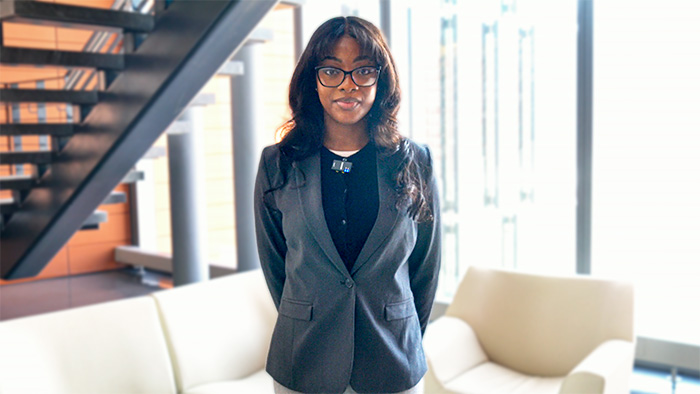


For Trinity Bowling, a senior computer science student at Bowie State University, the journey into research and autonomy wasn’t something she had planned from the start. Instead, it found her. Through her work with RITA, Trinity has gained hands-on experience, expanded her technical skillset, and built the confidence to see herself as a future engineer in machine learning or robotics. In this conversation, she reflects on how she got started, what she’s learned, and the future impact she hopes to make.
Q: Can you introduce yourself?
My name is Trinity Bowling. My major is computer science. I’m a senior undergraduate student.
What inspired you to join RITA?
I like to say that RITA came to me. When I first joined, I was not very familiar with it. One of my colleagues came up to me in class and told me that he thought I’d like it and that I’d be a good fit. So I did research and decided I wanted to join.
What drew you to your field of study?
Growing up, I’ve always liked science, and I was drawn to technology, especially creative technology. So I decided computer science would be the best path. I’ve also always liked robots, so I think I’m right where I need to be.
What is the most interesting or exciting thing you’ve experienced at RITA so far?
I would say probably working with Spot in the lab—the robot from Boston Dynamics. Learning how the user interface works and how you can apply your own programs to the robot was really cool. I wasn’t familiar with that before joining.
What does a typical day look like for you?
Typically, I go to class in the morning, and then after class I go straight to the lab. I work on whatever deliverable I’m assigned for the week. I’m usually in the lab from about 12 to 3, then I grab lunch, and from 3 to 6 I’m back in the lab continuing my work. Then I go home and join my online night class.
How has your experience at RITA shaped your career goals?
My time at RITA has definitely given me a lot of confidence. It’s a platform where I can bridge the theoretical side to hands-on experience in the industry. That’s something I struggled with before. I didn’t really know how to apply what I was learning in the classroom. This was a huge stepping stone for me.
What skills have you developed that you didn’t expect?
Programming in different languages. I’m now comfortable programming in Python and C++. Before, I was very Java-heavy, but now I’m more Python-heavy. Also, different deployment methods. I wasn’t familiar with things like dockerizing images before, but now I am. Getting familiar with different technologies has been a big help.
What do you enjoy most about working with your team?
What I enjoy most is that they help me step out of my imposter syndrome. I feel like a lot of students struggle with that, but working with others shows you that you’re not far off, you’re just where you’re supposed to be.
How has collaborating with others influenced your thinking?
It pushes me to think more outside the box. If we’re all asked the same question, I might have an answer, but my colleagues will go further. It makes me think, “Why didn’t I think of that?” and pushes me to think deeper next time.
Where do you see yourself in five years?
I’d like to be in the city and working as a machine learning engineer of some sort, and be pretty established.
What impact do you want to make?
I want people to know that stereotypes shouldn’t affect you. I was told many times that I couldn’t do the things I’m doing because of my skin color or my gender, but I kept pushing. I want to help people who face challenges because of how they look.
What advice would you give to students considering RITA?
Learn as much as you can while participating. I feel like this is the most learning I’ve done in my whole time in college.