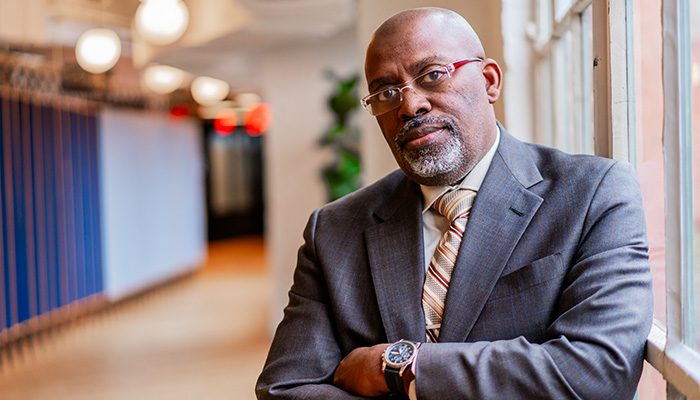

Dr. D Anthony Spann is the Research Institute For Tactical Autonomy’s Howard inaugural Insider Threat Program Senior Official and Facility Security Officer. He helped establish Howard’s industrial security program and provides security guidance to the university and its eight partner institutions in the RITA consortium. He brings more than 30 years of experience in security and compliance across government contracting, corporate, and academic settings.
We spoke with Dr. Spann about building a security program from the ground up, earning trust across the consortium, and what he values about the people who keep RITA running.
What brought you to RITA, and what interested you about bringing your security experience to a university research consortium?
Dr. D. Anthony Spann: I believe that security should never be perceived as an obstacle to innovation. I believe that it should enable innovation while keeping us accountable and protecting our information.
Being the inaugural Insider Threat Program Senior Official and the inaugural Facility Security Officer for Howard University gave me an opportunity to build that platform for the program. The opportunity to be the first to lay the foundation and build the environment where these things could take place was attractive to me.
How do you explain what you do as RITA’s Insider Threat Program Senior Official to someone hearing that title for the first time?
When people first hear “insider threat,” they think of a specific individual causing the problem, but a lot of times it may be something that’s unintentional. Because of a lack of understanding, training, education, or awareness, some well-intentioned people may make decisions that cause a consequence they didn’t expect.
When I explain it to people, I say I’m here to protect our people, protect our mission, protect the plan, and make sure we’re in compliance with those regulations and rules. I’m like a big brother who escorts people through the process so they can successfully attain the end result they’re looking for.
Walk us through a typical day. What does your work look like across both roles?
Since I play a dual role, a large part of my day is making sure that protective measures are in place and being followed. I’m checking that access restrictions are being followed and that access to different aspects of the contract is based on people’s roles.
For our future plans, we’re making sure things are in place to provide the atmosphere we need to move forward, to build, and to expand what we want to do as far as research. I’m also what you would call an internal process auditor. We’re making sure the processes are in place, that we’re able to get the results we desire within the parameters of the contract, and that we’re safeguarding the information being given to us.
What does it take to build a shared approach to security across nine universities?
Communication, understanding, education, and awareness. I would also say respect for what they bring to the table, what they offer, and validating their place in the consortium. That yields a more collaborative environment.
What has more than 30 years in security taught you about building trust and helping people feel comfortable coming to you with questions?
When people get emails from me, they’ll notice a statement in my signature block. It says, “Proactive prevention decreases reactive mitigation and is the essential element of best practices and secure success.”
If we’re proactive in our protection on the front end, we won’t have to react in chaos, because we took measures beforehand. To do that, we also have to take a whole-person perspective and look at all aspects of the program. The lesson I took was to honor where someone has been, what they’re doing now, and where they’d like to go. That breeds communication, understanding, and collaboration.
The lesson would be to listen to hear and understand what the directives are and what position I can be in to help that innovation while still staying within the parameters. I use the word “escort.” I escort them through the process. You want someone to know that you’re like a big brother, an usher, if you will, to help them accomplish what their actual goal is.
What would you like RITA’s security culture to look like in a few years, and what do you hope it makes possible for RITA?
I would like to view us as the necessary connecting tissue for moving muscles. We secure the movement that enables the accomplishments to come about. I would like to see the security culture as a welcomed, necessary element of what we’re trying to accomplish and what we desire to become. That means it has to be embraced as part of the character of who we are as RITA.
When you think about the people who keep RITA running, what’s one thing you wish more people knew about the work that happens at headquarters?
We are a collaborative and cross-functional group. We’re all subject matter experts in our fields, but we’re still general practitioners in some other areas. With that cross-functional aspect, we’re able to work together, especially in crunch times. We all take responsibility and ownership for our part, but it’s good to know that if you need a helping hand, someone can help where they’re able to.
We see each other. That means knowing who people are and the value they bring. We want to make sure we have a healthy working environment where we support one another and respect who people are. That’s what I love about HQ.