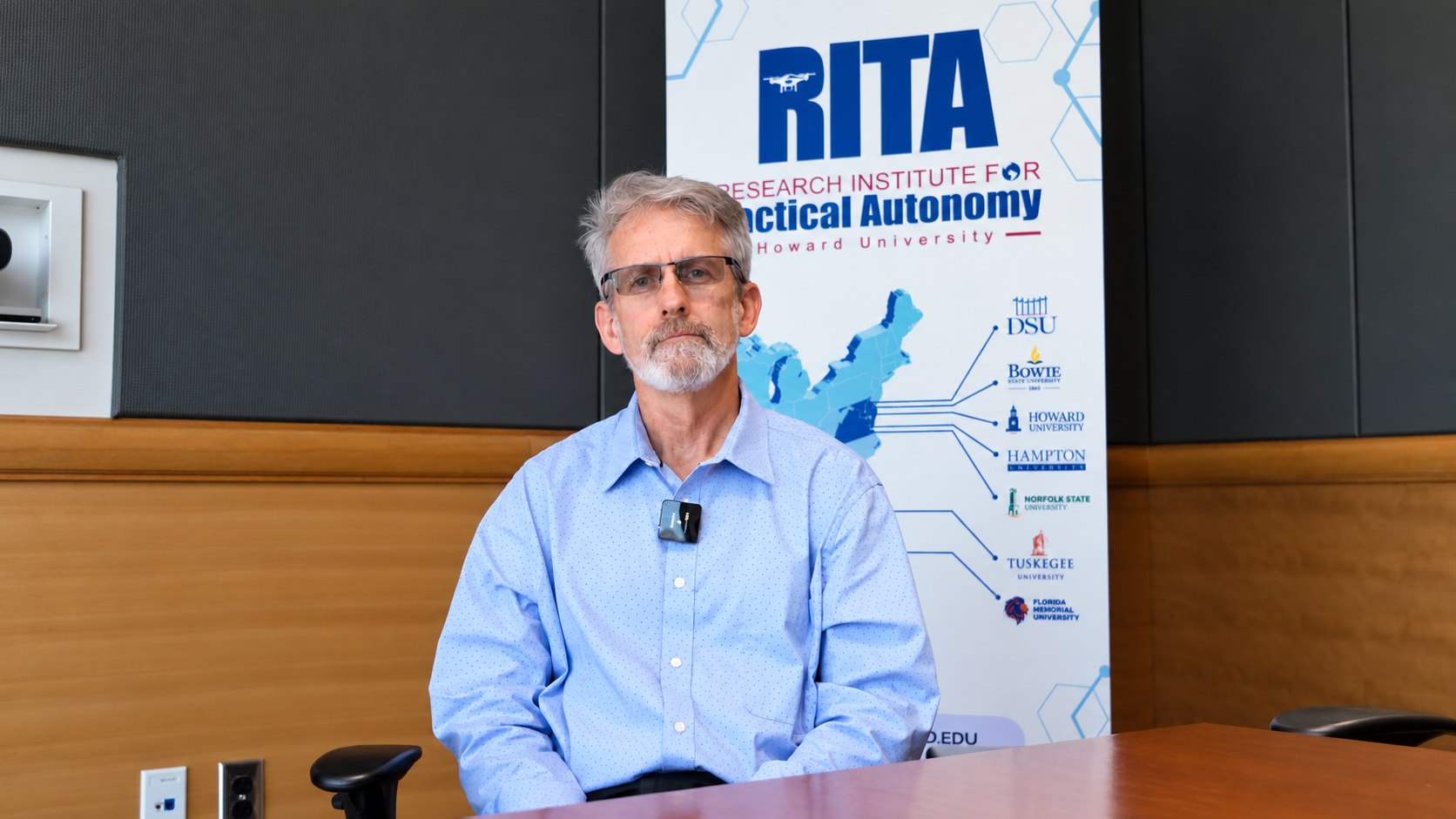


As a geophysicist, Dr. William Moore studies the interconnected systems that shape the Earth, from the atmosphere and oceans to the weather we experience every day. At Hampton University, his expertise brings an important environmental perspective to RITA’s work in tactical autonomy.
Through RITA, Dr. Moore is helping expand Hampton’s interdisciplinary research capacity while creating opportunities for students and faculty to contribute to emerging areas of autonomous systems research. For Moore, the work is not only about advancing technology, but also about developing the next generation of researchers who can bring a broader range of perspectives to the challenges those technologies are designed to solve.
Can you share a little about your background and your area of research?
I am a geophysicist interested in understanding how we measure and understand the Earth, its atmosphere, its oceans and how all of those systems work together to produce the weather we live and work in every day.
How does your field connect to RITA’s work in tactical autonomy?
You can’t operate anywhere without the weather, the Earth or the oceans affecting you. A very important part of autonomy is autonomously understanding the environment you’re operating in, so environmental awareness is a critical piece of autonomy.
The methods, techniques and instrumentation we use to understand weather and climate systems are applicable to the types of systems that can provide environmental awareness to autonomous systems.
Why are research partnerships like RITA important for institutions such as Hampton University?
Hampton University is a developing research institution, as are many of the universities within the RITA consortium. It is very important for institutions like ours to work across institutional and disciplinary boundaries so that we can bring together the resources and expertise needed to tackle big, serious problems like tactical autonomy.
These are challenges where we can make much more progress collectively than we could as individual institutions.
What is one RITA milestone that you are particularly proud of?
One of the milestones I’m most proud of is bringing additional researchers into the RITA cohort. A big part of developing Hampton University’s research capability through RITA has been expanding our faculty.
We have brought additional research faculty on board and engaged faculty from other departments, allowing us to develop a more cross-disciplinary approach and build a larger team. That increased capacity and capability also contributes back to the educational experience our students receive at Hampton.
What advice would you give students who are interested in entering this field?
Be curious. You’re only going to go as far as your passion drives you. If you find something you really want to understand and know more about, follow that curiosity and figure out what tools you need along the way.
Find something you’re passionate about and run it down. That can give you the foundation for a fulfilling career and help prepare you for whatever you decide to pursue next.
What impact do you hope your work through RITA will ultimately have?
The impact I hope to achieve through RITA is primarily centered on students and training them to contribute not only to tactical autonomy for defense applications, but also to solving broader societal problems.
That includes technological solutions, but also solutions that are aware of cultural context and the people being affected by them. I hope we can bring people into the rooms where solutions and decisions are being made who bring a wider range of perspectives and lived experiences. Ultimately, that can help us develop solutions that are responsive to the communities they affect.
What excites you most about the future of autonomy?
What excites me is the way autonomy will begin to filter into our everyday lives. I’m particularly interested in the technologies we need to better understand how our planet works and how we can make it work better for everyone. That will require better sensing and a better understanding of the state of our environment at many different levels, and autonomous systems are going to be critical to that endeavor.