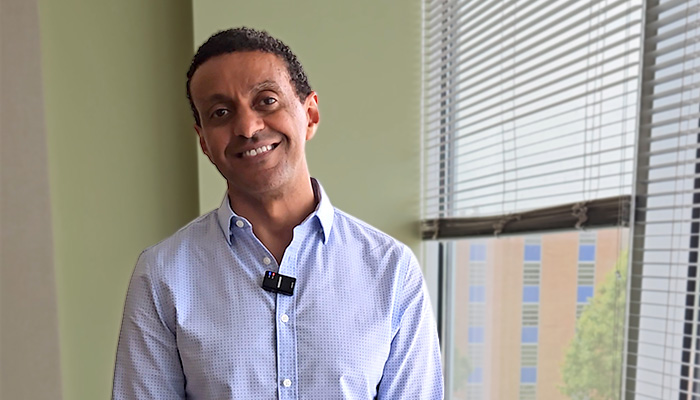


Dr. Henok Mawi is an Associate Professor of Mathematics at Howard University whose research focuses on mathematical modeling, optimization, and partial differential equations. His work explores how mathematical tools can be used to better understand and solve complex real-world problems. Through both his research and teaching, Dr. Mawi is committed to advancing mathematical discovery while helping train the next generation of scientists and engineers.
Can you introduce yourself and your research area?
Dr. Henok Mawi: My name is Henok Mawi. I am an Associate Professor of Mathematics at Howard University. My area of research focuses on mathematical models that can be described using partial differential equations or optimization problems.
What drew you to this field of study?
I’ve always been interested in addressing problems that stem from real-life situations. These kinds of problems are often studied through mathematical modeling. Mathematics is a very broad field, and these problems can be approached using different tools. Optimization is one of the main approaches, and that’s what really attracted me to this area of research.
How does your work contribute to RITA’s larger mission?
Many real-world problems can be addressed through optimization. This applies to the types of challenges RITA works on as well. For example, an unmanned aerial vehicle might need to determine the optimal path from one point to another while avoiding adversaries or obstacles. These kinds of problems are naturally framed as optimization problems, and that’s where my expertise contributes to the mission.
What have been some highlights of your work with RITA so far?
One of the biggest highlights has been learning from colleagues and discovering the different kinds of problems they are studying. Through those interactions, it becomes possible to build collaborations and work together to address RITA’s mission. Another highlight is the effort being made to support and train students who will become the next generation working in this field.
What impact do you hope your research will have over the next five years?
The impact of this kind of research takes two forms. One is proactively addressing problems that may arise from current developments in areas like artificial intelligence or machine learning. The other is training students. The students we train today will be the ones who take on these responsibilities and move the mission forward in the future.
What advice would you give to students interested in this field?
This type of research is very important and has practical applications in defense and across many STEM areas. However, the path can be challenging because it often involves heavy coursework in mathematics, physics, or computer science. It’s important to have perseverance, patience, and curiosity about the process. With that mindset, you can develop the expertise needed to succeed.
What do you enjoy most about working with students and collaborators?
Working with students is always enlightening. Students often bring different perspectives to a problem, and sometimes they approach it in ways I didn’t expect. That creativity is rewarding. It’s also very fulfilling to see students grow and achieve the goals they’ve set for themselves.