Advances in AI-Enabled Tactical Autonomy:
From Sensing to Execution

AAAI 2026 Spring Symposium

April 7-9, 2026 | Hyatt Regency SFO Airport, Burlingame, California

Organized by:

Research Institute for Tactical Autonomy (RITA), Howard University
Air Force Research Laboratory (AFRL)

Overview and Motivation

Uncrewed Aerial Systems (UAS) are increasingly central to modern defense, security, and disaster response operations. To perform effectively in contested, dynamic, or communication-denied environments, these systems must achieve true tactical autonomy, the ability to sense, reason, decide, and act robustly under uncertainty. While artificial intelligence (AI) and autonomy research has produced powerful algorithms in simulation and laboratory settings, a persistent gap remains between theoretical advances and their translation to field-deployable systems.

This symposium aims to bridge that gap by convening researchers and practitioners from AI, autonomy, sensing, and systems engineering to explore how to make autonomous UAS both theoretically principled and operationally effective.

The symposium seeks to foster dialogue between the AI and autonomy research communities and those engaged in operational field testing, defense research, and real-world deployment. By focusing on the integration of perception, reasoning, learning, and control across sensing and autonomy domains, this symposium will create a forum for identifying research bottlenecks, sharing best practices, and defining a roadmap toward resilient, explainable, and trustworthy UAS autonomy.

Goals and Objectives

The primary goal of this symposium is to create a sustained research conversation around the integration of AI and autonomy for UAS in tactical environments. Specific objectives include:

  • Highlighting theoretical advances in AI, perception, planning, and control that are applicable to tactical autonomy
  • Identifying real-world constraints such as computational, communication, and environmental factors that limit the transition of AI algorithms to practice
  • Fostering interdisciplinary collaboration between algorithm developers, system integrators, and end users
  • Promoting open datasets, shared benchmarks, and testbeds for evaluation of autonomous UAS systems
  • Defining ethical, explainability, and assurance frameworks for trustworthy tactical autonomy

Target Audience and Expected Impact

The symposium is designed to engage a diverse audience of AI researchers, autonomy engineers, sensor specialists, systems architects, and defense practitioners. It will serve as a convergence point for academic, industry, and government communities seeking to translate AI and autonomy research into deployable solutions for UAS.

Expected Impacts:

• Fostering cross-domain partnerships
• Identifying testable research hypotheses
• Seeding joint projects that connect fundamental research to fieldable prototypes
• Creating a sustained research community around tactical autonomy

Important Dates

Important Dates

Author Deadlines
January 30, 2026 Paper/Abstract Submission Deadline
• Submit abstracts or full papers via the AAAI EasyChair site.
• Required for inclusion in the AAAI Proceedings.
February 13, 2026 Acceptance Notifications
• Authors receive acceptance or rejection decisions.
• Page limits for camera-ready papers provided.
February 27, 2026 Final Accepted Papers Due / Camera-Ready Deadline
• Submit final revised accepted papers.
Camera-ready version due to AAAI for publication in the Proceedings.
Registration Deadlines
December 10, 2025 Registration Opens
• Online registration available on the AAAI website.
February 27, 2026 Refund Deadline & Late Registration Begins
• Last day to request a registration refund.
• Registration prices increase after this date.
March 30, 2026 Final Pre-Event Information Sent to All Registrants
• AAAI emails logistics info to all registered attendees.
Event Date
April 7–9, 2026 AAAI Spring Symposium Series
• Burlingame, CA (Hyatt Regency SFO)

Travel and Hotel Information

For your convenience, AAAI has reserved a block of rooms at the Hyatt Regency San Francisco Airport in Burlingame, California, USA. The hotel is located just minutes from SFO Airport, and downtown San Francisco is easily accessible, offering a variety of dining and shopping options. The hotel also offers complimentary airport shuttle service to and from the international airport terminals based on availability.

The conference room rate is $199.00 per night for either a king or double room.

Book Hotel Accommodations

Reservation Details

The above rates are subject to applicable tax, currently 12% Occupancy Tax + 1.50% San Francisco Peninsula Tourism Marketing District Assessment per room, per night, and are subject to change without notice.

Symposium attendees must contact the Hyatt Regency San Francisco Airport directly and request the group rate for the Association for the Advancement of Artificial Intelligence (AAAI) when reserving a room.

The cut-off date for reservations is Monday, March 16, 2026 at 5:00 PM PST, local time at the hotel. Reservations made after this date will be accepted based on availability at the hotel’s prevailing rate.

Policies

All reservations must be secured by a one-night deposit per room via credit card.

Reservations may be cancelled with no penalty up to 5:00 PM, 72 hours prior to arrival. After that time, a penalty of one night’s room and tax will be incurred.

Upon check-in, the date of departure must be confirmed. Early departure will result in a fee equal to one night’s guest room rate.

Hotel Address

Hyatt Regency San Francisco Airport
1333 Bayshore Highway
Burlingame, CA 94010

Transportation & Parking

The hotel offers a complimentary shuttle to and from SFO Airport based on availability. Please contact the hotel directly for additional details.

Hotel Parking Fees:

  • Overnight: $48.00 USD
  • Up to 1 Hour: $16.00 USD
  • Up to 6 Hours: $28.00 USD
  • 6+ Hours or Overnight: $48.00 USD

Symposium Schedule and Format

The symposium will be organized over two full days plus a half day (April 7-9, 2026) to encourage deep engagement between communities. Sessions will include invited keynotes, technical paper sessions, interactive panels, and hands-on demonstrations. Ample discussion time will be reserved for working groups to define open challenges and community goals.

Download the schedule

Detailed Schedule

Tuesday, April 7 +
  • 9:00am – 10:30am Opening Keynote -Dr. Reginald L. Hobbbs
    From Rules to Reasoning: The Army's AI Journey and the Research Frontiers That Matter Most
  • 10:30am – 11:00am Break
  • 11:00am – 12:30pm Technical Session 1: Causal Reasoning for AI Systems
  • 12:30pm – 2:00pm Lunch
  • 2:00pm – 3:30pm Panel Discussion: Bridging Lab to Field - Technology Transition
  • 3:30pm – 4:00pm Break
  • 4:00pm – 5:30pm Technical Session 2: Trustworthy, Explainable, and Evaluated AI
  • 5:30pm – 6:30pm Reception
Wednesday, April 8 +
  • 9:00am – 10:30am Keynote - Nathaniel Bastian
    The Need for Operational AI Red-Teaming in the Department of War
  • 10:30am – 11:00am Break
  • 11:00am – 12:30pm Invited Talk - Dr. Francesco Restuccia
    Toward (Truly) Resilient Networking and Learning in Tactical Cyber-Physical Systems
  • 12:30pm – 2:00pm Lunch
  • 2:00pm – 3:30pm Technical Session 3: Multi-Agent Systems and Distributed Tactical Autonomy
  • 3:30pm – 4:00pm Break
  • 4:00pm – 5:30pm Technical Session 4: Autonomous Sensing, UAS, and ISR Systems
  • 5:30pm – 6:30pm Plenary Session
Thursday, April 9 +
  • 9:00am – 10:30am Technical Session 5: Decision Intelligence, LLM Reasoning, and Human-AI Collaboration
  • 10:30am – 11:00am Break
  • 11:00am – 12:30pm Technical Session 6: Embodied AI, Robotics, Bio-AI, and Physical Systems

Accepted Technical Sessions

Session 1: Causal Reasoning for Artificial Intelligence Systems +
  • Causal Learning for Fault and Anomaly Detection in Unmanned Aerial Systems
    Atul Rawal
  • Discussion of Artificial Intelligence from an Artificial Reasoning Perspective
    Adrienne Raglin
  • Uncertainty-of-Information-Driven GAN (UoI GAN): Quantifying and Communicating Uncertainty to Decision-Makers
    Sunny Anjon Basak, Rajendran Swamidurai, Adrienne Raglin
  • Adversarial Causal Deception Scenarios: Preliminary Modeling and Policy Formation
    Milo Fritzen, Andrew Forney, Adrienne Raglin, Sunny Basak, Peter Khooshabeh
Session 2: Trustworthy, Explainable, and Evaluated AI +
  • Distilling Deep Reinforcement Learning into Interpretable Fuzzy Rules: An Explainable AI Framework
    Simon Khan, Sanup Araballi, Chilikuri Mohan
  • LLM Forensic Evaluation: Diagnosing Actionability, Uncertainty, and Human Comprehension in High-Stakes Outputs
    Jaye Nias, Saurav Aryal, Christopher Watson, Jeremy Blackstone, Simone Smarr, Lucretia Williams, Gloria Washington
  • Evaluating Generative Image Expansion for Long-Range Maritime Vision Tasks
    Jaye Nias, Saurav Aryal, Joseph Sankah, Jeremy Blackstone, Armisha Roberts, Simone Smarr, Lucretia Williams, Gloria Washington
  • Adaptive Interception in Dynamic Domains: Exploration of Hybrid Reinforcement Learning in Pursuit-Evasion Tasks
    Matthew Akinmolayan, Darsana Josyula, David Casbeer
  • From Rules to Reasoning: Evolving Agentic AI for Strategy Synthesis in Multi-Agent Wargaming Environments
    Amauri Straford, Anaiya Reliford, Charles Milligan
  • Ethics, Trust, and Explainability in Autonomous Decision Systems: Lessons from Neuroscience
    Alex Evans
Session 3: Multi-Agent Systems and Distributed Tactical Autonomy +
  • Communication-as-Control: Intent-Aware Interaction for Scalable Multi-Agent Coordination
    Mahdi Iman, Tian Lan
  • AI-Against-AI Conflict in Distributed Tactical Autonomy
    Mahdi Iman, Tian Lan
  • Predictive Auxiliary Learning for Belief-based Multi-Agent Systems
    Qinwei Huang, Rui Zuo, Stefan Wang, Simon Khan, Garett Katz, Qinru Qiu
  • Resilient and Adaptive Autonomy Using Multi-Agent Reasoning
    Josef Schaff
  • Causal Representation Learning for Generalizable Multimodal Understanding: A Case Study in Social Media Post Classification
    Pingchuan Ma, Chengshuai Zhao, Bohan Jiang, Saketh Vishnubhatla, Ujun Jeong, Alimohammad Beigi, Adrienne Raglin, Huan Liu
Session 4: Autonomous Sensing, UAS, and ISR Systems +
  • Systemic Evaluation of Lightweight YOLOv8 for Real-Time Aerial Detection
    Moath Alsafasfeh, Mandoye Ndoye, Dewan Noor
  • On the Utility and Limitations of the MSTAR Dataset for Deep Learning-Based SAR Target Recognition
    Charles Milligan
  • Toward a Closed-Loop Autonomous Sensing Framework for UAS-Based Particulate Matter Mapping
    Aniaya Reliford, Sonya Smith
  • Aerial-borne Data Management Center (ADMC)
    Chieh Tsai, Hossein Rastgoftar, Salim Hariri
  • A Decentralized Framework for Resource-Constrained Task Redistribution
    Doron Reid, Anaiya Reliford, Anietie Andy, Sonya Smith, Marcus Alfred, Sean Phillips
Session 5: Decision Intelligence, LLM Reasoning, and Human-AI Collaboration +
  • Symbolic Mediation of Language-Based Decision Support in Tactical Contexts
    Jaye Nias, Lashaun Baddol, Saurav Aryal, Jeremy Blackstone, Simone Smarr, Lucretia Williams, Gloria Washington
  • Reasoning Knowledge-Gap in Drone Planning via LLM-based Active Elicitation
    Zeyu Fang, Beomyeol Yu, Cheng Liu, Zeyuann Yang, Rongqian Chen, Yuxin Lin, Mahdi Imani, Tian Lan
  • Design Considerations for Augmented Reality Supported Tactical Decision Making Systems
    Simone Smarr, Alexis Davis, Niya Tranham, Nicholas Abram, Saurav Aryal, Jaye Nias, Lucretia Williams, Jeremy Blackstone, Gloria Washington
  • A Comparison of Reinforcement Learning and Optimal Control Methods for Path Planning
    Qiang Le, Yaguag Yang, Issac Weintraub
  • Egocentric Team AI: Enabling Tactical Reasoning from the Operator's View
    Soham Hans, Yunzhe Wang, Volkan Ustun
Session 6: Embodied AI, Robotics, Bio-AI, and Physical Systems +
  • Repari2Skill: A Vision Language Action Framework for Robotic Furniture Repair
    Mukesh Mani, Huang Xin, Qingping Li
  • Cloud-Orchestrated Autonomous Bioreactor Arrays for Closed-Loop Strain Characterization
    Carlos Barajas, Justin Edaugal, Samuel McKey, Seneca Bessling
  • Transformer-Based Classification of Parkinson's Disease from EEG Using BIDS-Formatted OpenNeuro Datasets
    Raven Lee, Caleb Cooper, Manliang Feng, Jinghe Mao
  • Time-Aware Two-Dimensional Packing for Slicing-Aware 3D Printing Throughput Optimization
    Saurav Aryal, Stephone Christian, Montaque Blayne
  • A Unified Naming and Addressing Scheme for Hybrid DTN/NDN Communication Protocols
    Ronald Langrin, Jeremy Blackstone

Session Types:

  • Invited Keynote Talks: Two distinguished speakers presenting state-of-the-art in AI foundations and sensing systems
  • Technical Paper Sessions: Five peer-reviewed research sessions covering theory, systems, and integration
  • Panel Discussion: Interactive discussion on bridging research to operational deployment
  • Plenary Session: Community roadmap discussion and future directions

Featured Symposium Speakers

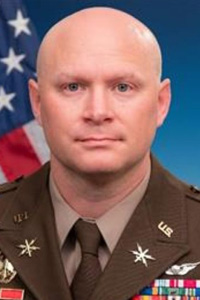
Headshot of Reginald L. Hobbs

Dr. Reginald L. Hobbs

Branch Chief, Content Understanding Branch, DEVCOM Army Research Laboratory

Devcom Army Research Laboratory

Headshot of Dr. Nathaniel D. Bastian

Nathaniel D. Bastian, Ph.D.

Program Manager, AI & Cyber Operations

DARPA

Headshot of Dr. Francesco Restuccia

Francesco Restuccia, Ph.D.

Assistant Professor, Electrical & Computer Engineering

Northeastern University

Organizing Committee

Lead Organizer

Dr. Atul Rawal
Research Institute for Tactical Autonomy
Howard University

Co-Organizer

Dr. Simon Khan
Air Force Research Laboratory

Sponsoring Organizations:

Contact Information

For inquiries about the symposium, submission guidelines, or participation opportunities, please contact:

Dr. Atul Rawal
Research Institute for Tactical Autonomy (RITA)
Howard University
Email: atul.rawal@howard.edu
Website: https://rita.howard.edu/

© Research Institute For Tactical Autonomy 2026. All Rights Reserved. 

1328 Florida Ave NW, Washington, DC 20009