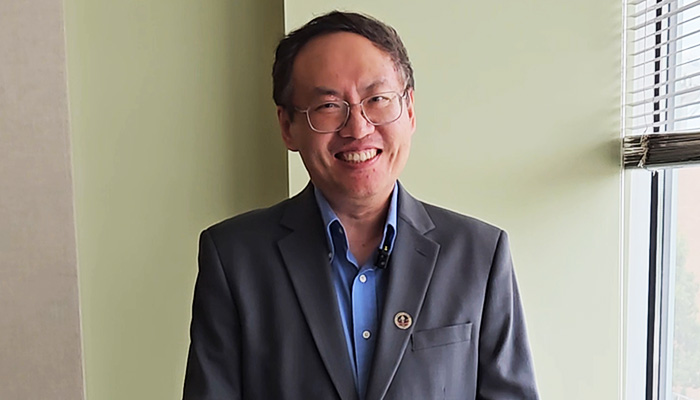


Dr. Bo Yang is a Professor in the Department of Computer Science at Bowie State University, whose work bridges advanced artificial intelligence research, student mentorship, and real-world impact. In Fall 2025, Dr. Yang was appointed by Maryland Governor Wes Moore to serve as the Education Sector Representative on the Workgroup on Artificial Intelligence Implementation, a state-level advisory body charged with monitoring AI developments and providing policy recommendations that guide responsible and ethical AI adoption across Maryland. The appointment reflects Dr. Yang’s expertise in big data, language models, and trustworthy AI, as well as his commitment to ensuring that emerging technologies serve the public good. In addition to his state leadership role, Dr. Yang serves as a Principal Investigator on multiple RITA UARC projects, where he works closely with students to apply cutting-edge AI research to real-world challenges.
Q: Can you please state your name, field of study, and institution?
Dr. Bo Yang: My name is Dr. Bo Yang. I’m a professor of computer science, and I’m also a PI on several RITA projects. I want to thank RITA for this great opportunity. It gives us the opportunity for our students to apply what they’ve learned in the classroom to real problems.
Q: Can you share a bit about your background and what brought you to RITA?
My background is in language models and language processing. I was brought to the UARC because we have close collaboration with Howard as well as other universities with state-of-the-art research in AI. We are happy that our expertise and interests match what the Department of War needs, and that our students have this opportunity as well.
Q: What first sparked your curiosity or passion for computer science and technology?
We’ve observed many applications that we’ve never seen before, especially large language models. We see ChatGPT and other applications that are smart enough to talk like people and give helpful information. That really sparked my interest. At the same time, we also see challenges, like [AI driven] hallucination and other issues, which lead us to think about trustworthy AI. That gives us interest in helping our students dig into research and find solutions to these problems.
Q: What excites you most about the future of this field?
AI is the future. It’s becoming more involved in human life, and we’re trying to make it more helpful. Our students have done a wonderful job with not only growing academically but also contributing to the broader community by developing smarter and more trustworthy AI. We’re excited about applications in areas like medicine, smart homes, and biomedical fields.
Q: What do you enjoy most about working with your students and collaborators?
I enjoy working with everyone and I’m very thankful for the support from the university. I enjoy meeting with my students every week and seeing how their ideas grow. We find new applications and directions together. I also enjoy working with DoW partners and the UARC team, brainstorming ideas and figuring out how to move the project forward. It’s all been a wonderful experience.