




News

RITA Research Assistant Brandon Newton Named IBM Master’s Fellow
Photo by Mia M. Johnson/Jackson State University

News
Dr. Denise Jones Gregory Named President of Jackson State University
Dr. Denise Jones Gregory has been officially appointed as the 14th president of Jackson State University following a nationwide search. Having served as interim president
News
Advances in AI-Enabled Tactical Autonomy: From Sensing to Execution Hosted by the Research Institute For Tactical Autonomy
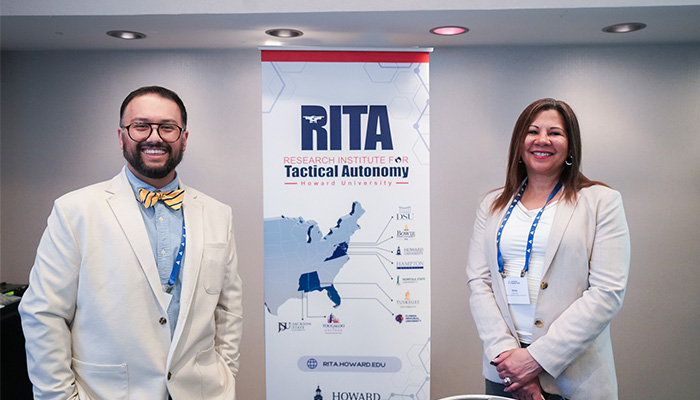
From April 7–9, the Research Institute for Tactical Autonomy (RITA) hosted its first symposium as part of the Association for the Advancement of Artificial Intelligence Spring Symposium Series in Burlingame, California. The three-day event, titled Advances in AI-Enabled Tactical Autonomy: From Sensing to Execution, convened researchers, engineers, and practitioners from academia, government, and industry to explore how emerging AI technologies are shaping autonomous systems in real-world environments.

News
Student Spotlight: Trinity Bowling
The path into research and autonomy was unexpected for Trinity Bowling, senior computer science student at Bowie University. Through her work with RITA, she has gained hands-on experience, expanded her technical skillset, and built the confidence to pursue a future in machine learning and robotics.
News
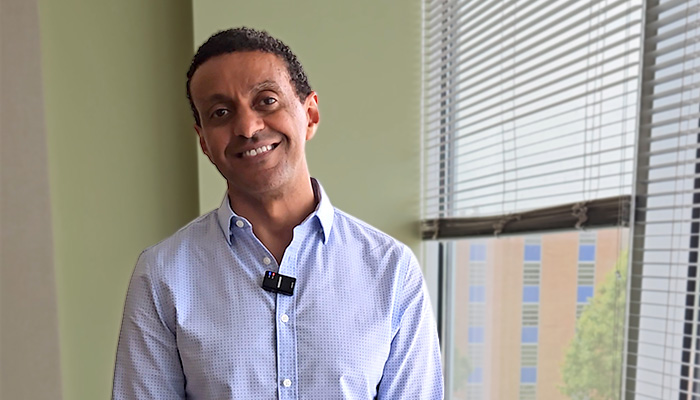
Researcher Spotlight: Dr. Henok Mawi
Howard University Associate Professor of Mathematics, Dr. Henok Mawi explores how mathematical tools can be used to better understand and solve complex real-world problems. In addition to his research, Dr. Mawi is dedicated to mentoring students and preparing the next generation of mathematicians and researchers.

News
Researcher Spotlight: Dr. Armisha Roberts
At the intersection of human-centered computing and tactical autonomy, Dr. Armisha Roberts is building technologies designed not just to advance innovation, but to protect people. A Research Scientist at Howard University, Dr. Roberts brings a deeply personal mission to her work: ensuring that emerging AI systems support safe, timely decision-making in high-stakes environments.