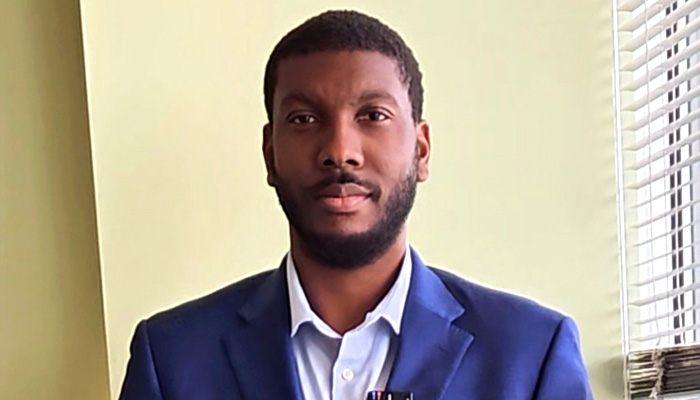

Driven by a fascination with turning ideas into real, tangible solutions, Assistant Professor of Computer Science, Dr. Jeremy Blackstone has built his career at the intersection of cybersecurity, embedded systems, and applied AI. He brings this expertise to RITA, where he collaborates with students and researchers to advance technologies that strengthen communication and decision-making for the Air Force.
Can you begin by sharing your name, your institution, and your field of study?
Hi, my name is Dr. Jeremy Blackstone. I’m an assistant professor at Howard University in the Electrical Engineering and Computer Science department, and my focus is in Computer Science.
I received a scholarship at Howard University in computer science, where I completed my bachelor’s and master’s degrees in systems and computer science. During that time, I engaged in research on behavioral cybersecurity.
Eventually, I completed my Ph.D. in embedded systems security at the University of California San Diego.
How does your work contribute to RITA’s larger mission?
My work helps provide more solutions for getting accurate data on how to communicate between different devices used by the warfighter in conducive environments.
What drives your passion for this work?
Ensuring that our nation is able to keep track of its assets, as well as those of our adversaries, so that we can achieve our mission and deter the missions of any adversaries.
What first sparked your curiosity for your field?
The ability to turn an idea in my head into something I could physically implement. I was able to take an idea, explore it, and quickly get feedback on a viable solution. That drove my interest in computer science.
How do you mentor or guide students on their academic journey?
I’m a firm believer in modeling. I walk students through my academic journey as I pursued my Ph.D., and I provide artifacts from my own work as a baseline as they prepare their own.
What professional milestones are you most proud of?
Generally, I was honored to receive Students’ Choice Professor of the Year for my teaching at Howard University.
With RITA specifically, one of my students was able to use the RITA project toward his dissertation work. He laid out what he was doing for the project, it was well received, and he reached candidacy based on that work. That was a huge milestone.
How do you celebrate big wins like those?
I make an announcement to the group and invite everyone to congratulate the student, not just on the research call, but individually and encourage them to learn from it.
One student achieving something great is powerful, but it’s even more meaningful when it motivates others to do the same.
What impact do you hope your work will have in the future?
I hope my work will provide more on-ramps for people to engage with technology, specifically as it relates to the military, the Air Force, and other parties that would benefit from this research.
What’s a fact about you that people may not know?
When I was 18 years old, I had a heart attack. I was medically considered dead for 20 minutes, received CPR, and had open heart surgery.
How did that experience shape your perspective on life and teaching?
It shaped how I view life. I felt like I had a second chance, so my mission has been to provide second chances for others.
This philosophy informs my teaching: I offer makeup exams, extra credit that enriches students’ education, and multiple opportunities to support students who may face emergencies or setbacks.
If someone asked why your work matters, what would you say?
From a research perspective, I want to improve accuracy and precision of devices on one project, and enable different communication protocols to interact with each other on another.
I want the students I mentor to go into academia and industry and provide amazing solutions for everyone.
I’m doing my best to pass on all the lessons I’ve learned to the next generation so the work doesn’t end with me.