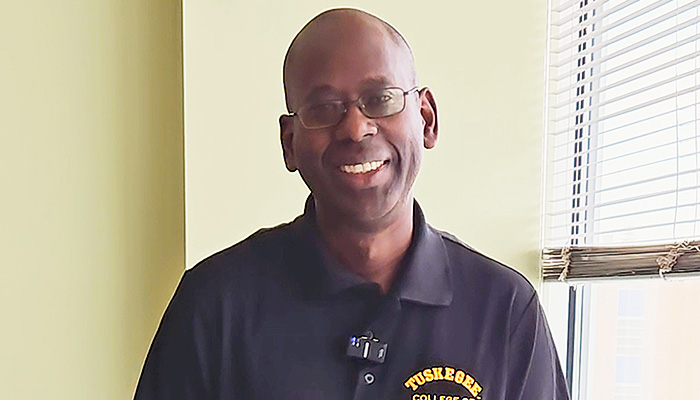

Dr. Mandoye Ndoye’s journey from mathematics to engineering reflects a deep commitment to research and student development. Now a professor at Tuskegee University in the Department of Electrical and Computer Engineering and an active contributor to RITA’s mission, he brings expertise in digital signal processing and a passion for solving real-world challenges, particularly those tied to autonomous systems and Air Force applications.
Q: Can you begin by sharing your name, your institution, and your field of study?
Dr. Mandoye Ndoye: My name is Dr. Mandoye Ndoye, and I’m a faculty member in the Department of Electrical and Computer Engineering at Tuskegee University. My field of study is digital signal processing.
Can you share a bit about your academic and professional background, and what brought you to RITA?
I did my undergraduate studies at Rensselaer Polytechnic Institute in upstate New York, which was the first school to award a Civil Engineer degree in the United States. After that, I came to Howard University and completed my master’s degree. I then earned my PhD at Purdue University.
After completing my PhD, I returned to Howard as a post-doc, and later joined Tuskegee University where I am now.
What first sparked your interest in engineering?
Originally, I was a math student, and I even have a master’s in math. When I came to the U.S., I became an engineering student.
What sparked my curiosity was being able to see what you’re doing—to solve a problem that has a visible application. Math is very interesting, but engineering lets you see the solution in a different way.
What drives your passion for this work?
Two things. First, I like to do research that is interesting and has a direct impact.
Second, I think it’s very important to help students develop research skills and get more people interested in this type of work.
What makes this very exciting is not just doing research and writing papers, but seeing a direct implication of your work and actually helping the Air Force solve problems.
What professional milestones are you most proud of?
Recently, I became a full professor. That’s the one that comes to mind right now.
What excites you about the future of this field?
Tactical autonomy involves a lot of AI. We are now talking about connecting AI to the physical world, and that aligns well with what we are doing, which is merging AI with real systems.
What advice would you give to students or young professionals interested in this type of research?
Definitely find a good mentor. You don’t want to reinvent the wheel or repeat mistakes that others have already made. A mentor can share lessons they’ve learned and help you move forward.
What guidance do you have for students seeking mentorship?
If there’s a faculty member you’re interested in working with, email them and let them know you’re interested in research and would like a mentor. Many people want to mentor students because there is benefit in it for both sides.
How has mentoring students shaped your own growth as a faculty member?
When you mentor students, you learn how to assist people with different perspectives, interests, and personalities. That helps you learn how to communicate and collaborate better.